| SEXUALITY AND LANGUAGE, COMPLEX RELATIONSHIPS. From revue "sexologies" vol.
II, n°9, sept. 1993. Marseille. |
The ability to express one's thoughts requires more than being merely endowed with the faculty of speech. Sexual matters, particularly, are uneasily translated into language. We are all aware of the censorships which, together with the veil of modesty, occult sexuality. Has human modesty, a phenomenon which is both physical and verbal, been sufficiently studied? Putting forward taboos about the primitive scene or verbal modesty boils down to giving as an explanation what is to be explained, thus harbouring ignorance. We all know that the "lusts of the flesh" belong to the domain of interdicts. They cannot be put down to our own culture solely: every human community formulates interdicts about sexuality. In addition to the unconscious phenomena, which have been largely described, there are censorships the individual is aware of, that affect him both in his words and in his acts. Verbal modesty is one of these: its range goes from an attitude of reserve to a feeling of violation of privacy. These silences do not originate only in external pressures; they are shaped by the individual's psychological background. Desires are present, but thoughts cannot be formulated into words: enunciation is unnameable to the mind. The result is a number of linguistic distortions, inhibitions, inversions. If, in its sexual behaviour, the animal goes straight to the point, F. Perrier emphasizes that, with human beings, "once the language intervenes, all that was green becomes red... we have to use metaphors, metonymies, shifts in meaning, condensation of ideas, weakening of the meaning." But, before examining the transformations that bring about a sayable and acceptable message, we feel it is important to identify more precisely what is changed, what is removed from the language, what remains unsaid. Our prevailing impression might be that, nowadays, a lot of things can be said in the domain of sexuality. First, there is the scientific outlook. Indeed, science has made great progress; its language has greatly improved too. Of course, we no longer write in Latin. If we did, it might be improper, and shock prudish people. Some will say that ceasing writing in Latin was not necessarily an improvement. For how can we be quite sure that we now write in modern languages what they formerly wrote in the scholarly language? In any case we use a scientific language which has to be abstract. Therefore the clinical difficulty does not lie there: it lies in the personal concrete stating of these same realities. We know more and more about sexual physiology, but sexual psychology has hardly differentiated itself from ethology. While eroticism, its true field, has not been studied scientifically yet, in spite of Freud's works. Strangely enough, the study of eroticism has been postponed because of the very theories of Freud : it was taken for granted that the sexual function bred its own taboos and interdicts. The cause was not to be looked for elsewhere than in the repressive social requests lying heavy on desires. Other linguistic alterations were well known but they were derived through symbols from sexual taboos. The problem closed upon itself. Clinic, which only verified their strength, identified through them the good integration of the individual. The later advance of psychoanalysis, the contribution of post-Saussurean linguistics and structuralism have made it possible to consider the relations between language and sex differently. We perceive there exists between the two an antonymous ontological opposition which, besides sexuality, equally affects all functions of the body, eating, drinking, excremental functions to begin with the most elementary. Excremental functions are generally occulted, except for cracking jokes about them. We have learnt a great deal from the ritualization of eating, and its symbolic analogies with the rules of sexual behaviour. On the whole, table manners are equivalents of modesty; their transgression is completely similar to the taboo of incest. It is not a derived symbolism but a specific adjustment to being prohibited the satisfaction of natural needs: for a being endowed with the faculty of speech, the satisfaction of any bodily need must be provided with a meaning. Thus the conjunction of alcohol and sex enriches our knowledge: it must be pointed out that alcoholism brings about a reaction of modesty when a permanent need can no longer be satisfied during the usual accepted circumstances. Everybody shields their sex life from the social scene; in the same way the alcoholic hides he is in want of alcohol when his desire is not consistent with the cultural system of symbols. He hides his ingestion of alcohol just as one draws a veil over one's sexuality. His act may not be shown or told, so that we notice linguistic deformations identical in every respect with what takes place when he speaks of his sex life. Insincerity, they say; actually, psychological blocks, inhibitions, definite inversions: "I drink like everybody!" means exactly the opposite. This inversion is not peculiar to sexuality: whether they speak of alcohol or sexuality, "when they say no they mean yes." The inversions and hindrances perturbing the circuit of speech occur in every circumstance sharing with genital eroticism the submission of the mind to the bodily act. These phenomena are linked by a common characteristic: subordination to the body. 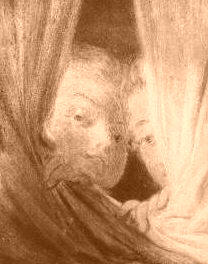
Fragonard : Les curieuses. Therefore it is an elementary observation that we use the right words when our body obeys us, and the wrong words, or no words at all when the mind is to obey the body. Such is the case in the tragedy of alcoholic dependence; this is true, too, of sexual pleasure, which serves it well. Everyone can perceive that a job, a hobby, a walk in the country can be talked about more easily than intimate relations which are differently translated into words. Love life implies that the mind be receptive to lust, be in its service, submit to it, contrary to what takes place in work, sports, chaste leisure activities for which the constraints and desires acknowledged by the mind guide the body which obeys it. Sexual pleasure does not have to be named in order to exist. However, to make love, one has to speak about it, and this message needs a language. Barring rape, sexual intercourse requires a double encounter : with the body and the mind of the mate. It is in the "courtship ritual" of humans that words are inverted, or that their meaning is altered. Silence takes the place of speech which may act as a screen. The implicit message being understood, the womanizer will take a roundabout way and perform feats of language not unlike "amour courtois", court poetry, literature, and drama. Love words do not directly point out their purpose. Implicit and explicit messages must not coincide; a factual wording would be clumsy. He would miss his goal, for sexual intercourse and words are mutually exclusive. Now making love when feelings are involved is something else. It is an interchange motivating and rousing both lovers, although it merges with pleasure itself. The merging of sexual pleasure with what induces it and gives it significance characterizes the act of love. The message and its meaning cannot be distinguished. To use terms of linguistics, the signified and the signifier are merged into one reality, which rules out the emergence of a meaning. The act is consumed but in this case it is neither an object nor an intermediate substance between the two beings. That accounts for the subversive power of sex and the concomitant regression. This complete merging of pleasure with the act bringing it about, accounts for the peculiarities of physical love : the oversight, or even appropriation of the mate, reduced to his or her body or part of it, and above all the unavoidable suspension of language. Is it necessary to state that there is no room for words in the most intense moments of love? Orgasm and chatter do not get on well together. Orgasm is conditioned by a release that foregoes language, and the "phonic gestures" that take its place are not words. But so decisive a function in our social life as sexuality cannot be meaningless. The innermost depths of ourselves cannot escape thought. An inner language is necessary for appropriating one's own body, one's own sex. Thanks to it we can acknowledge the act and our pleasure. This is mainly a secret language: a ransom of culture, it is paradoxically indispensable to the sexual function. It makes it find its place in cultural syntax and thought, and exist in the person. Therefore it allows us to exist. Like Oriental erotic arts, our sexual education wants to organize this initiatic language about love, and give a meaning to the sexual act. But, unlike Oriental cultures, our "sexual education", emptied of its emotional content by the scientific point of view, finds it difficult to find an approach to sexuality. This accounts for the use of some technical innovations in order to get round that deficiency, such as erotic magazines and electronic mail, pornographic video-tapes, which support intermediate links with body signifiers. But the meaning is necessarily distorted: an unavoidable contradiction. Major and minor perversions also help to understand the important part played by this inner language. In every case, the manifest motive of the act is no longer lust. It is characteristic of our culture that it is the carrying out of such or such performance, figure, alibi, conversion of objectives, shift in meaning that justifies sexual pleasure. Erotic figures, perversions, cultural expressions or the indispensable sexual fantasies, make appropriate signifiers, thanks to which the message and its meaning get separated, thus establishing sense. 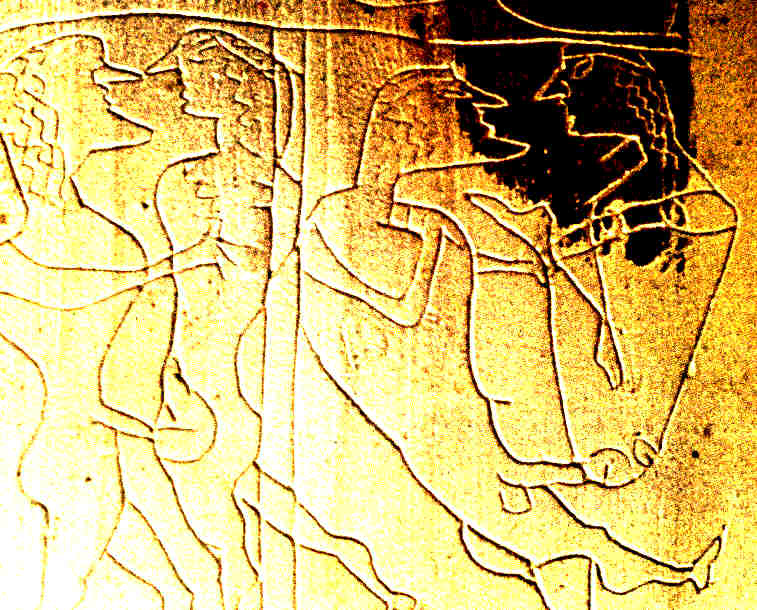 Etruscan pottery For there can be no appropriation of the world except through the mediation of signs. So that we are confronted with the paradox of a human activity denied by language, and licit only if one has been beforehand equipped with an appropriate language. We are given access to the forbidden fruit only in the name of something: "growing and multiplying" for god-fearing people, tally of successes for the womanizer, power of seduction for the vamp, while a pervert checks his ritual. Both thought and language use words and signs, and, as we know, it is the language that renders sex possible. 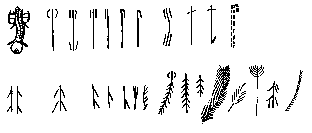
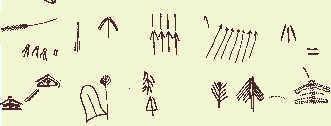
From Leroy-Gourans, "La préhistoire de l'art occidental" : Male signs. Societies which drawn rupestral documents used an elaborated language. Sexual initiation thus arised to them as an ontological need. Should we be astonished that the first graphic symbols, referring to human being, was precisely related to the sex (and look like modern graphitti)? |
| Retour à l'Index |
| Site créé le 02 août-1997. - Dr J. Morenon, 8 rue des tanneurs, F-04500 RIEZ |
|